Sade Sati Survival Guide: What Actually Happens, Calmly Explained
 Purohit Ji · 2026-09-12 · 10 min
Sade Sati might be the single most feared phrase in popular astrology. People postpone weddings over it, avoid job changes over it, and sometimes spend real money trying to "cancel" it. Almost none of that fear is coming from what the classical texts actually say. It is coming from how the phrase gets used.
This guide is meant to be read the way its title suggests: as a survival guide, not a warning label. It explains what Sade Sati (Saturn's roughly seven and a half year transit relative to your Moon sign) actually is astronomically, walks through its three phases one by one, states plainly what classical doctrine associates with each, and then spends real time on what does not change, because that is the part most fear-based explanations leave out entirely.
What Sade Sati actually is, astronomically
Strip away the fear, and Sade Sati is a description of where the planet Saturn happens to be, relative to where the Moon was at the moment you were born.
Every birth chart has a Moon sign (rashi), the zodiac sign the Moon occupied at your birth. Saturn, meanwhile, is always moving slowly through the zodiac, spending roughly two and a half years in each of the twelve signs before moving to the next one. Sade Sati is simply the name for the stretch of time when transiting Saturn is positioned in one of three specific signs relative to your natal Moon sign: the sign just before it, the sign itself, or the sign just after it.
Because Saturn spends about two and a half years in each of those three signs, the whole cycle runs roughly seven and a half years, which is where the name comes from ("sade sati" means "seven and a half" in Hindi, referring to those seven and a half years). This product computes it precisely for any birth chart: whether it is active right now, which of the three phases you are in if so, the exact start and end date of the current phase and of the whole window, and, if it is not currently active, the date your next window begins. All of that comes from real Saturn ephemeris positions, calculated sidereally with the Lahiri ayanamsa, not from a lookup table that assumes everyone with a given Moon sign shares the same dates.
One computational detail worth mentioning, because it matters for accuracy: Saturn does not move in a straight line through the sky from Earth's point of view. It periodically appears to slow down, stop, and briefly move backward (retrograde) before resuming forward motion. This means Saturn can cross back over a sign boundary it had already passed, dip briefly into the previous sign, then cross forward again. A naive calculation would report that as two separate Sade Sati windows with a gap in between, which is misleading. This engine bridges those short retrograde dips into one continuous window, so the dates you see reflect the actual lived experience of the transit rather than an artifact of how Saturn's apparent motion works.
The most important thing to understand about all of this is also the most reassuring: Sade Sati is not a rare affliction that lands on a few unlucky charts. It is a transit relative to the Moon, and Saturn transits every sign in turn, which means every single person eventually goes through Sade Sati relative to their own Moon sign. Over an average lifetime, most people experience it two or three times. It is a normal, repeating part of the human life cycle as classical Jyotish (Vedic astrology) describes it, not a unique curse singling anyone out.
The three phases, one by one
Sade Sati is not one undifferentiated seven and a half year block. It has three distinct phases, each defined by exactly where transiting Saturn sits relative to your Moon, and classical tradition associates a different general theme with each one.
First phase: the rising phase
The first phase begins when transiting Saturn enters the sign just before your natal Moon sign, counted as the twelfth sign from the Moon. This is the opening roughly two and a half years of the cycle.
Classical association: this phase is often read as touching the self and personal habits, including health routines and daily discipline. Think of it as the setup phase, where the groundwork for the rest of the cycle tends to get laid. This is a general classical association, not a guaranteed personal outcome, and it plays out differently depending on the rest of your chart.
Second phase: the peak phase
The second phase is when transiting Saturn moves directly into the sign of your natal Moon itself, the same sign the Moon occupied at your birth. This is the middle roughly two and a half years, and it is usually described as the most intense of the three.
Classical association: because Saturn is now sitting directly over the Moon's own placement, this phase is traditionally read as touching the mind, emotional steadiness, and closest relationships most directly. It is often described as the phase asking for the most patience. Again, this is a classical theme, not a fixed script; a well-placed, strong natal Moon experiences this very differently from a stressed one.
Third phase: the setting phase
The third phase begins when transiting Saturn moves into the sign just after your natal Moon, the second sign from the Moon. This is the final roughly two and a half years before the whole cycle closes.
Classical association: this phase is often associated with finances and family responsibilities, sometimes framed as a period where the practical, material consequences of the earlier two phases come to a head and get resolved. It is frequently described as a settling phase, the point where the restructuring of the earlier years starts to pay off if it was handled with consistency.
It is worth repeating the caution here directly: these three thematic associations are how classical texts generally describe the tenor of each phase. They are not a guarantee of what will happen to any specific person, and they should never be read as a countdown toward something bad. The three phases have genuinely different character, which is exactly why treating the whole seven and a half years as one uniform "bad period" gets the doctrine wrong from the start.
What genuinely tends to change
It would be dishonest to swing so far toward reassurance that we pretend classical doctrine says nothing at all. It does say something, and it is worth stating plainly, without exaggeration in either direction.
Classical texts associate the Saturn transit relative to the Moon with a period of restructuring: a stretch of life where old patterns, especially loose or undisciplined ones, tend to get tested and often need to be rebuilt on steadier footing. Saturn in Jyotish is the planet of structure, patience, time, and consequence, so a period defined by its transit relative to your emotional center (the Moon) is traditionally read as a call toward more discipline, more responsibility, and more consistent effort, particularly in the areas Saturn's themes naturally touch: career structure, health habits, and family obligations.
Framed constructively, this is closer to a multi-year invitation than a sentence. Classical astrologers have long described this transit as a teacher more than a punisher: it tends to reward steady, patient effort and expose whatever was built on shortcuts. That is a very different thing from misfortune arriving at random. It is closer to a long stretch where consistency compounds, and where cutting corners tends to show its cost sooner than it otherwise would.
What does not change: the myths worth retiring
This is the core of a survival guide: not just what happens, but what doesn't, because a great deal of unnecessary fear gets attached to Sade Sati that has nothing to do with the actual doctrine.
Myth: Sade Sati guarantees disaster, illness, or ruin. This is false, and it is worth debunking directly rather than softening. No classical text treats this transit as a prediction of death, guaranteed illness, or certain ruin for anyone. Claims like that are fear-based exaggeration layered on top of the doctrine, not the doctrine itself. If you hear this framing, treat it as a red flag about the source, not as information about your chart.
Myth: the entire seven and a half years is one uniform bad stretch. Also false, and covered above: the three phases have different classical themes and different character. Treating the whole window as one undifferentiated span of misfortune, and therefore avoiding all major decisions or life events for seven and a half years straight, is not what the doctrine supports and is not a reasonable way to live.
Myth: the transit alone decides the outcome. This gets the emphasis backward. Your own chart's strength, how well-placed your natal Moon is, how Saturn sits natally, and the condition of the rest of your chart, matters more than the transit by itself. The exact same Saturn transit lands very differently on two different charts. This is precisely why this product computes Sade Sati individually from your real birth data instead of handing everyone the same fear-based script regardless of their chart.
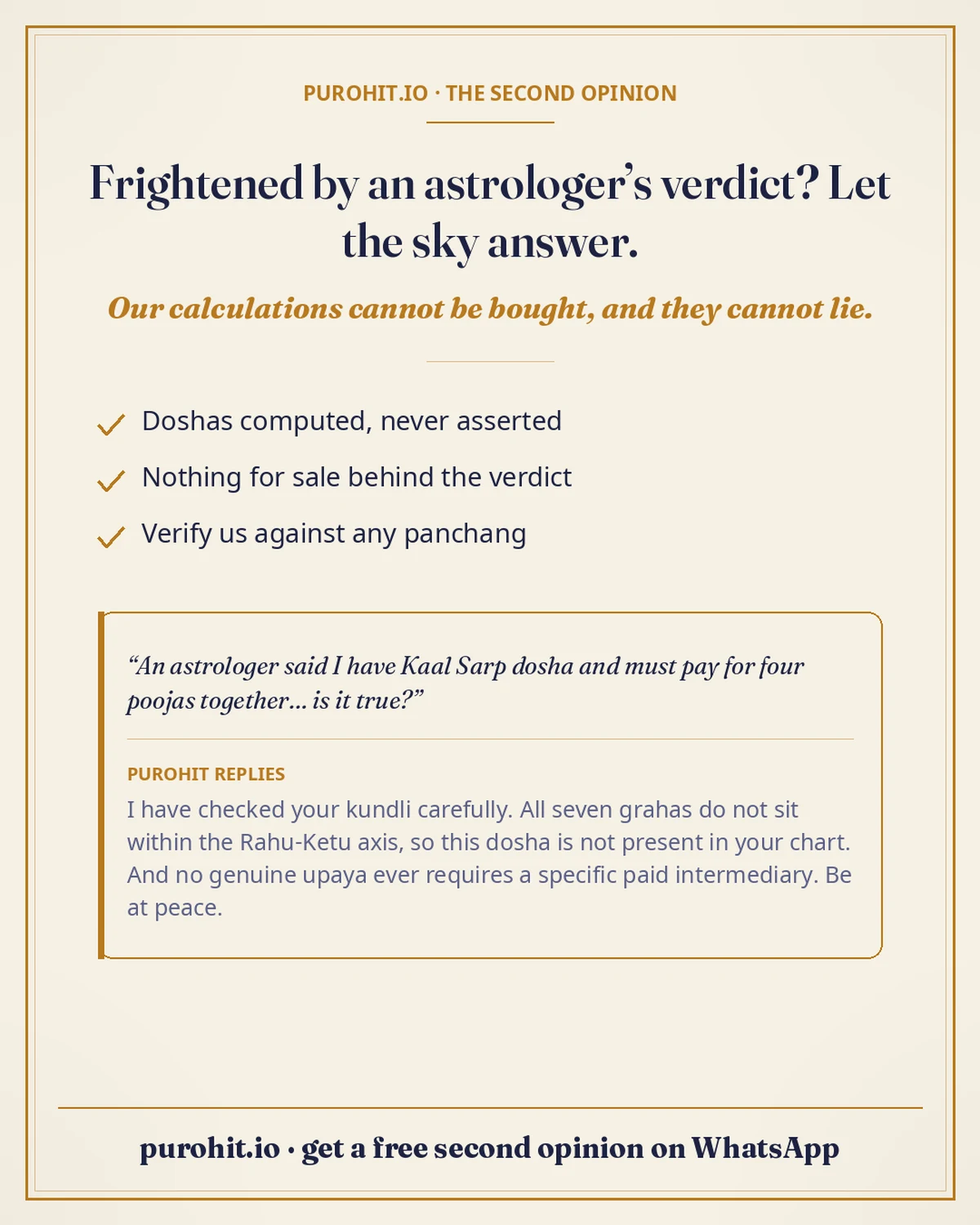
Myth: you need to buy something to fix it. No. Sade Sati is not a curse that requires a purchased remedy, an expensive pooja package, or a specific gemstone to neutralize. It is a period to plan around with patience and consistent effort, the same way you would plan around any known, temporary period of extra demands on your time and discipline. If someone tells a family they must spend a significant amount of money to "cure" a normal, universal planetary transit, that claim deserves real skepticism before any money changes hands.
A practical way to think about it
The most useful mental model here is planning, not dread. Sade Sati is a known, dateable, multi-year window, so treat it the way you would treat any long, foreseeable stretch that calls for more discipline than usual: build structure where you can, keep health habits steady, be a little more deliberate about financial commitments, and expect that consistent effort compounds more visibly during this period than during an easier one.
What you should specifically avoid is going by generic, year-based rules of thumb (the kind that say "everyone born under this Moon sign has Sade Sati from this year to that year") without checking your own actual dates. Those generic tables ignore your personal Moon sign's precise position and Saturn's real, sometimes retrograde, motion through the sky. Two people with the same Moon sign but different exact birth times can have meaningfully different windows once the real ephemeris is used. Check the computed dates for your own chart rather than borrowing someone else's timeline.
Check your own dates
You do not need to live with a vague, borrowed fear of "the Sade Sati years." You can see, precisely, whether it is active for you right now, which of the three phases you are in, and the exact date your current phase (and the whole window) ends, computed from your real birth details rather than a generic table.
Try the free Sade Sati calculator, or read more in Sade Sati explained and the Sade Sati reference.
If you would rather talk it through, message Purohit directly on WhatsApp: chat with Purohit. Purohit is not a human astrologer and gives no medical or legal advice, but it will show you your own computed Saturn transit timeline, phase by phase, instead of asking you to be afraid of a date range that may not even apply to your chart.