A Real Kundli Reading for Wealth, Yoga by Yoga
 Purohit Ji · 2026-09-12 · 7 min
Most astrology content asks you to take a claim on faith: this chart is "good for money," that placement is "auspicious," trust us. We want to do something different. We are going to take one actual kundli, computed by the same sidereal engine that runs every reading on Purohit, and walk through exactly why classical Jyotish would call it a wealth-favorable chart, term by term, connection by connection, so you can see the reasoning instead of just being handed the conclusion.
Rohan is a fictional persona used to illustrate how Purohit's engine reads a real, computed kundli. No real person's birth details appear anywhere in this article.
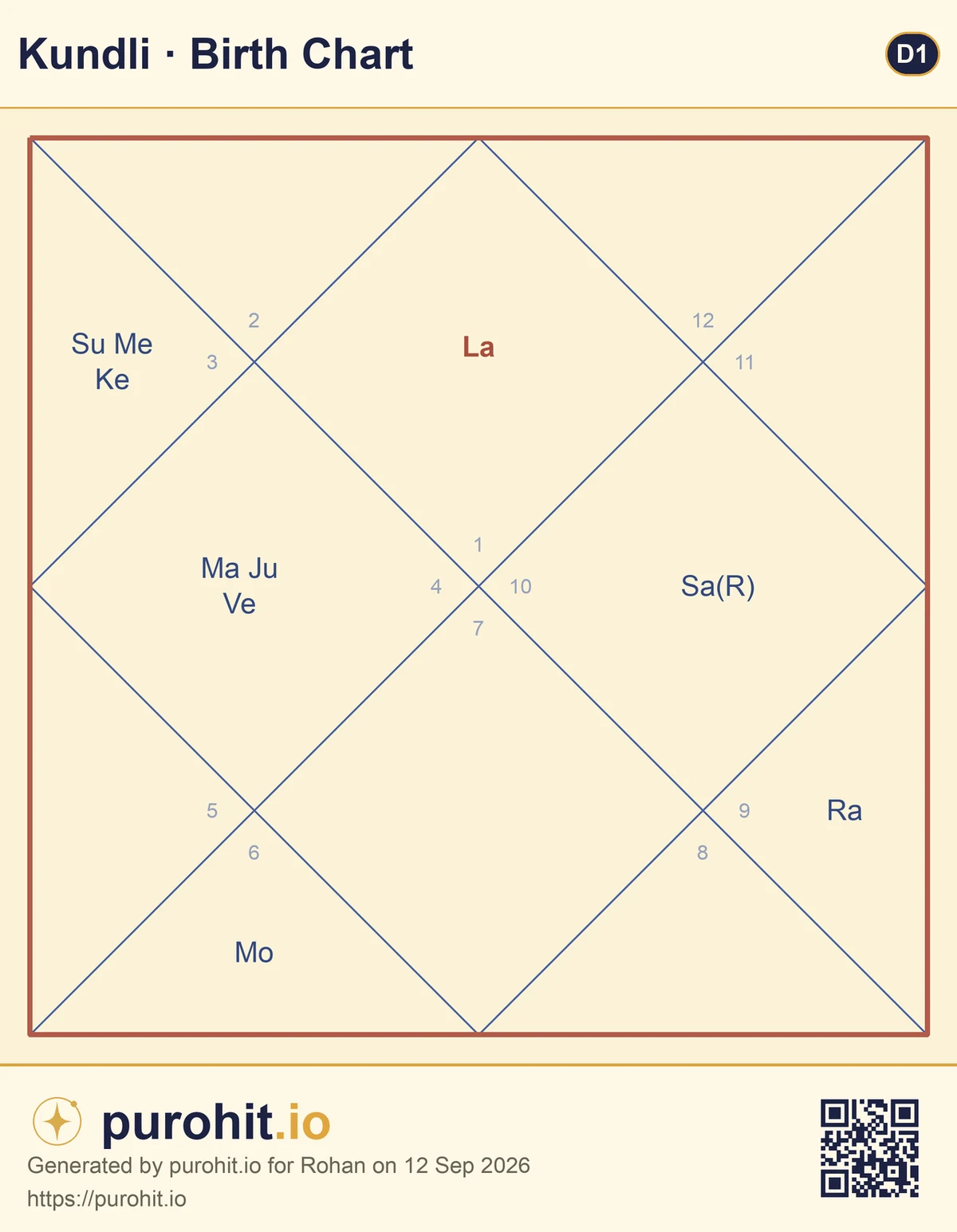
For this walkthrough we used a birth detail set, run exactly as any user's would be: 21 June 1991, 3:15 AM, Mumbai. We gave the result a name, Rohan, purely so the article reads like a conversation rather than a table of coordinates. Every fact below, the lagna, the house lords, the yogas, the dasha dates, came straight out of that one computed chart. Nothing here was chosen after the fact to fit a narrative.
The chart at a glance
The lagna, or ascendant, is the first house of the kundli: it represents the self, the body, and the lens through which every other house is read. In this chart the lagna falls in Aries, ruled by Mars. That single fact sets the frame for everything that follows, because in classical Jyotish, a wealth combination only counts for as much as the strength of the chart's own ruling planet, Mars, behind it. A dhana yoga sitting in a chart with a weak or afflicted lagna lord reads very differently from the same yoga sitting, as it does here, alongside a lagna lord that is actively participating in the wealth picture.
Five dhana yogas, unpacked
Dhana yoga is the general classical name for a combination in which the lords of the money-related houses connect to each other, whether by sitting together, aspecting each other, or exchanging houses. Vedic astrology pays particular attention to three houses when it comes to material wealth: the 2nd house (money already earned and saved), the 9th house (fortune, dharma, and the wealth that comes through merit or luck), and the 11th house (income, gains, and the fulfillment of desires). A dhana yoga is essentially evidence that these three houses are not operating in isolation, that they are wired into each other.
This chart carries five such connections, and they are worth naming individually rather than waving at as a single vague "good for money" signal.
The clearest one is a conjunction: the 2nd lord Venus and the 9th lord Jupiter sit together in the 4th house. Read plainly, that means the planet governing saved wealth and the planet governing fortune and dharma are not just both present in the chart, they are sitting in the same house, actively combined. That is about as direct as a 2nd-9th connection gets.
The lagna lord Mars, the ruler of the self, also connects to Venus. Because Mars is the chart's own ruling planet, this means the person themselves, not just an abstract house lord, is linked into the money picture. A dhana yoga that only involves house lords without any tie back to the ascendant lord tends to read as more theoretical; one where the lagna lord is directly in the mix reads as more personally activated.
Finally, the 11th lord Saturn, the planet of income and of desires actually being fulfilled, is in mutual aspect with both Jupiter and Venus. A mutual aspect means the planets are looking at each other, exchanging influence both ways, rather than one simply glancing at the other. With this in place, all three of the houses classical Jyotish watches for wealth, the 2nd, the 9th, and the 11th, are now connected through their lords: Venus to Jupiter directly, Mars to Venus, and Saturn back to both Jupiter and Venus. That is the shape of five separate dhana yoga connections sitting in one chart, each one reinforcing the same basic claim: money earned, fortune, and income are not separate stories here, they are one interconnected story.
Hamsa yoga, a Pancha Mahapurusha yoga
Classical Jyotish sets aside a special category, the Pancha Mahapurusha yogas ("five great person yogas"), for five specific planets when each reaches a particular kind of strength: sitting in its own sign or exalted, while also placed in a kendra, one of the four angular houses (the 1st, 4th, 7th, or 10th) counted from the lagna. These are treated as marks of real distinction in a chart, not everyday placements.
In this chart, Jupiter qualifies for the Hamsa yoga, the Pancha Mahapurusha yoga named for Jupiter specifically. Jupiter sits exalted in Cancer, and Cancer here falls in the 4th house, a kendra from the Aries lagna. Exaltation is the strongest dignity a planet can hold, and combining that with an angular house is exactly the two-part condition Hamsa yoga asks for. Given how central Jupiter already is to the dhana yoga picture above, finding it in one of the five great-person yogas as well is not a coincidental extra, it is the same planet showing up strong in a second, independent classical test.
Lakshmi yoga
Lakshmi yoga takes its name from the goddess associated with fortune and abundance, and classical texts define it around a fairly specific condition: it forms when the 9th lord is dignified (exalted or in its own sign) while sitting in a kendra, and the 1st lord, the lagna lord, is also strong. This chart matches that description directly. Jupiter, the 9th lord, is exalted in the 4th house kendra, and Mars, the lagna lord, is itself connected into the wealth picture through its link to Venus rather than sitting isolated or weak.
It is worth being precise about what classical texts say this yoga does. Lakshmi yoga is read as fortune that tends to hold over time rather than arriving and vanishing quickly, an invitation for sustained good fortune rather than a certificate guaranteeing it. Like every yoga in this article, it describes a tendency built into the chart's structure, not a promise about a specific future event.
Why now: the Jupiter mahadasha
None of the above matters much without timing, and this is where the Vimshottari dasha system comes in. Vimshottari divides a lifetime into mahadashas, extended periods each ruled by one planet, based on the Moon's position at birth. During a planet's own mahadasha, classical astrology treats that planet's significations as more active and more likely to express themselves in a person's life.
In this chart, the current mahadasha belongs to Jupiter, running from 2015 to 2031. Look back at everything above: Jupiter is the 9th lord sitting exalted in a kendra for Hamsa yoga, it is the other half of the direct Venus conjunction at the center of the dhana yoga picture, and it is the planet whose dignity and placement trigger Lakshmi yoga. Jupiter is not a minor player anywhere in this chart's wealth story, it is the single most connected planet across all three classical tests. Having that exact planet run its own multi-year period is close to the textbook definition of a chart's wealth-planet period activating a wealth-heavy chart.
What this does not mean
We want to be direct about the limits of all of this. Nothing above tells you that a windfall is coming, and nothing in any legitimate branch of Jyotish, whether Parashari, Jaimini, or any regional tradition, works by naming a specific date for a specific sum of money to arrive. What a chart reading like this can honestly say is narrower and, we think, more useful: this is a chart where the classical wealth indicators, dhana yoga, Hamsa yoga, and Lakshmi yoga, genuinely stack together, and where the currently running period happens to be ruled by the exact planet tying all three together. That is a statement about structure and timing, not a prophecy about outcome. How a person acts, the choices they make, and circumstances well outside any chart all still matter.
Get your own reading
If you want to see this kind of analysis run on your own birth details rather than a fictional example, you can build a free chart at /kundli in a couple of minutes. If you would rather learn to read the placements yourself first, /learn/how-to-read-a-kundli walks through the basics of houses, lords, and lagna the same way this article did. And if you are curious which other classical yogas show up across different charts, from the challenging to the auspicious, /yoga is our running index of them.
Or skip the reading and just ask. Purohit is a Vedic astrologer you can talk to directly on WhatsApp, built on the same classical doctrine and the same computed astronomy engine behind everything in this article. Say Namaste on WhatsApp and bring your own birth details, we will read the chart the same way, live.