Manglik Dosha Myths: What Mangal Dosha Really Means
 Purohit Ji · 2026-09-12 · 7 min
Mangal dosha, the affliction people usually mean when they call someone "manglik," might be the most weaponized term in popular astrology. It gets used to scare people out of matches, to sell four-figure remedy packages, and to end conversations before they start. None of that is what the classical texts actually ask for.
This post lays out what Mangal dosha actually requires, exactly how Purohit's engine checks it (no hand waving, this is the real logic), and the myths that have grown up around it. The goal is not to dismiss the tradition. It is to give you a calm, honest, defensible second opinion the next time someone uses "manglik" as a scare word.
What Mangal dosha actually is
Mangal dosha (an affliction from Mars's placement, often called being manglik) is a classical Jyotish condition based on where Mars sits in a birth chart. It is not a personality trait, a curse, or a prophecy. It is a placement, the kind of factor that a chart carries alongside dozens of others: strengths, weaknesses, and things worth being aware of.
The check works by locating Mars and counting its house position two separate ways:
- From the lagna (the ascendant, the sign rising on the eastern horizon at the moment of birth).
- From the Moon sign (the rashi the Moon occupied at birth).
Both counts use whole-sign houses, the traditional Parashari method where each sign is treated as one full house, counted forward from the reference point. This is the same houses system BPHS-based (Brihat Parashara Hora Shastra) charts use throughout, not a special exception invented for this one dosha.
Because the check is run twice, from two different reference points, a chart can be manglik "from lagna," manglik "from Moon," both, or neither. A serious reading says which is true, rather than collapsing everything into a single yes or no with no explanation.
Exactly how this engine checks it
Here is the mechanic Purohit's engine runs, without simplification, because a claim like this should be checkable rather than taken on faith.
The engine looks at Mars's sign, then computes its house number from the lagna and, separately, from the Moon, using whole-sign counting. It then checks whether either of those two house numbers falls in this set:
Houses 1, 2, 4, 7, 8, and 12.
If Mars lands in any of those six houses, counted from lagna or from the Moon, the chart carries Mangal dosha from that reference point. The overall verdict, manglik or not, is true if either the lagna count or the Moon count lands in the list. Both do not need to agree.
Why this particular set of six houses, and not a shorter list? Different regional traditions actually disagree here, which is itself one of the myths worth naming directly (more on that below). North Indian practice sometimes narrows the list by dropping house 2. South Indian practice sometimes narrows it by dropping house 1. Rather than pick one regional convention and imply it is the only one, this engine deliberately follows the broader union of both lists, the same six houses Drik Panchang publishes. That is a stated choice, not an accident, and it means this check is, if anything, more inclusive than some regional variants, not less.
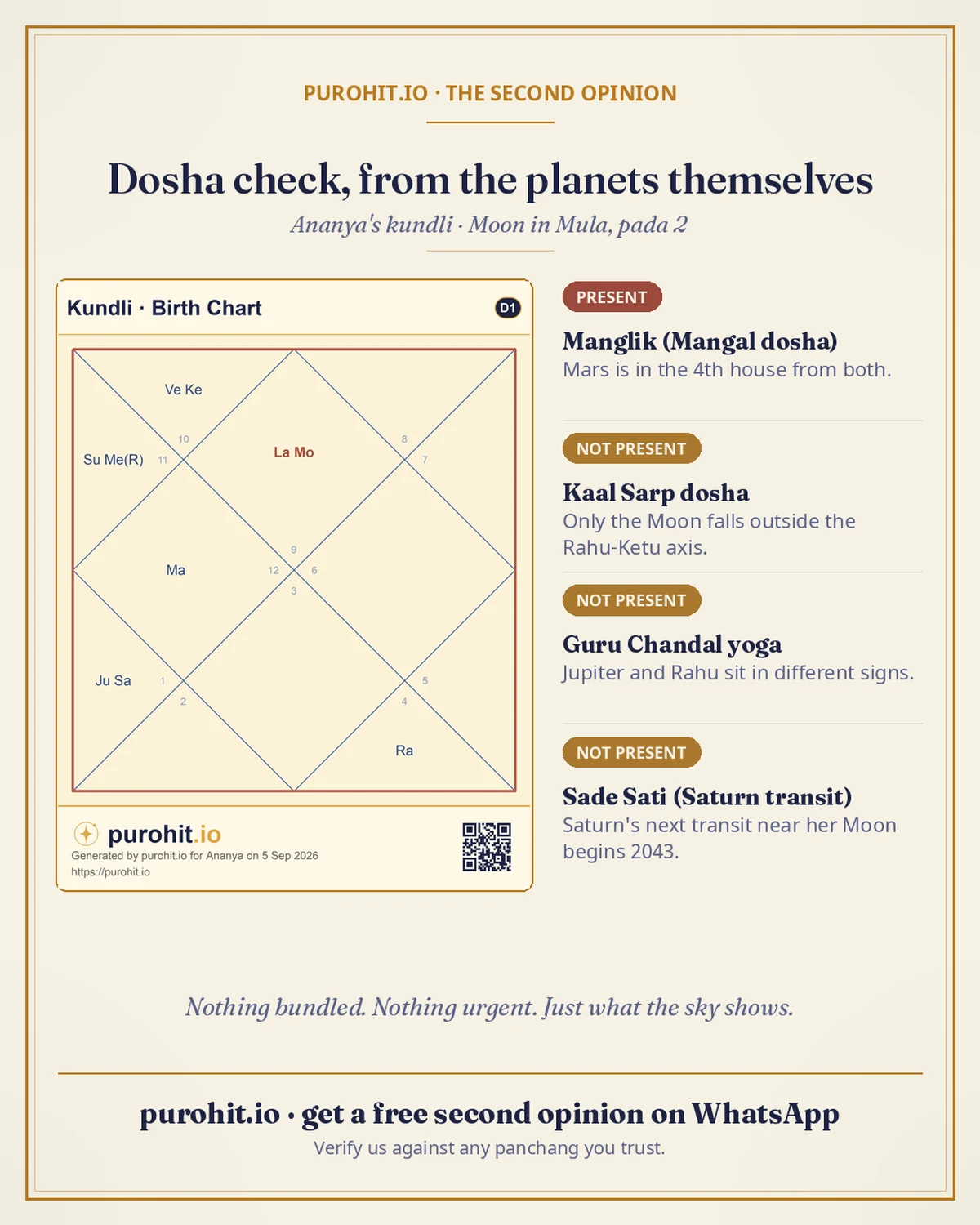
A brief, fictional illustration: suppose a persona named Ananya has Mars in the 4th house counted from both her lagna and her Moon sign. Since house 4 is on the list, and Mars is not sitting in Aries, Scorpio, or Capricorn (the two cancellations below), Ananya's chart would come back manglik from both lagna and Moon, with no cancellation present.
Ananya is a fictional persona used to illustrate how the check works. No real person's birth details are used here.
The two real cancellations, and what is deliberately not implemented
Classical Jyotish includes the idea of nivarana, cancellation conditions that reduce or remove a dosha's weight even when the placement technically qualifies. Purohit implements exactly two, chosen because they are the least contested across traditions:
- Mars in its own sign. If Mars sits in Aries (Mesha) or Scorpio (Vrischika), the sign it rules, the placement is treated as strong rather than afflicted, and the dosha is cancelled.
- Mars exalted. If Mars sits in Capricorn (Makara), its exaltation sign, the same cancellation applies.
That is the complete list this engine acts on. It is worth being direct about what is left out, and why. Some practitioners also treat Mars being retrograde, Mars being debilitated (which, notably, is the opposite condition from exaltation and is argued by some to soften a dosha rather than worsen it), or specific aspects from benefic planets as cancelling factors. Those rules exist in parts of the tradition. This engine does not apply them, because they are contested enough across schools that encoding them as settled fact would be misleading. Rather than quietly picking a side, we say so plainly: those are known variants, not gaps we forgot to close.
There is also a stricter check some practitioners layer on top, sometimes called the Venus chart or Bhrigu variant, which re-runs the same six-house test from Venus's position instead of the lagna or Moon. This is a real, documented approach in parts of the tradition. Purohit does not implement it in this version. If someone tells you your match failed a Venus-based manglik check, that is a different, stricter method than the one described here, and it is worth asking which convention they are using before treating the verdict as final.
The myths, addressed one by one
"Manglik dosha means your marriage is doomed, or someone will get hurt"
This is a myth, and a fear-based one. Classical doshas are afflictions to understand and plan around, the way you would note that a chart is Saturn-heavy or Moon-weak. They are not curses, and no reputable classical text frames Mangal dosha as a prediction of death or catastrophe. If someone tells you a manglik chart guarantees tragedy for a spouse, that claim is not coming from the doctrine itself. It is coming from fear, and fear sells.
"Every astrologer checks it the same way"
Also a myth. As covered above, the house list itself varies by regional tradition, and the cancellation rules vary even more. A serious astrologer, human or engine, should tell you which convention they are using rather than presenting one regional variant as universal law. This engine uses the union list (houses 1, 2, 4, 7, 8, 12) and exactly two cancellations, and says so.
"You have to spend money on remedies to fix it"
This is where a lot of real-world harm happens, and it is worth being blunt about it. Purohit computes the dosha and its two documented cancellations for free, with no remedy sold as part of that computation. If someone tells you that you must perform four specific poojas, buy a particular gemstone, or pay for a "correction ritual" to neutralize a manglik chart, check the actual computed chart first, ideally against more than one source, before paying anyone for anything. A real placement is worth understanding. It is not, by itself, a reason to spend money on a stranger's say-so.
"If one partner is manglik, the match is automatically off"
Also not what the tradition asks for. Manglik status is one input among many that go into a serious compatibility read, alongside guna milan, dasha compatibility, and the rest of the chart. It is a factor to discuss openly, not a single flag that ends the conversation. The next section covers one specific reason why: when both people carry the same placement, classical practice has an answer for that too.
When both partners are manglik
Here is a detail that gets left out of most fear-based explanations. In classical practice, when both people in a potential match are manglik, that is itself treated as a form of mutual cancellation, sometimes called dosha samya: affliction balancing affliction. Purohit's matching logic reflects this. It does not mean the topic disappears from the conversation, but it does mean "we are both manglik" is closer to neutral ground than to double trouble. This is a good example of how classical doctrine, read carefully, tends to be more measured than the popular version of it.
Check it for free
You do not need to take anyone's word for a manglik verdict, including ours. Purohit's manglik calculator runs the exact logic described here, on your own birth details, for free, with the house list and any cancellations shown plainly rather than asserted. Try the free manglik calculator, or read more in Manglik dosha explained and the manglik dosha reference.
If you would rather talk it through, message Purohit directly on WhatsApp: chat with Purohit. It is not a human astrologer and does not give medical or legal advice, but it will show you exactly how your own chart computes, houses and cancellations included, instead of asking you to trust a verdict you cannot check.