Kundli Milan the Proper Way: What the 36 Gunas Actually Mean
 Purohit Ji · 2026-09-12 · 7 min
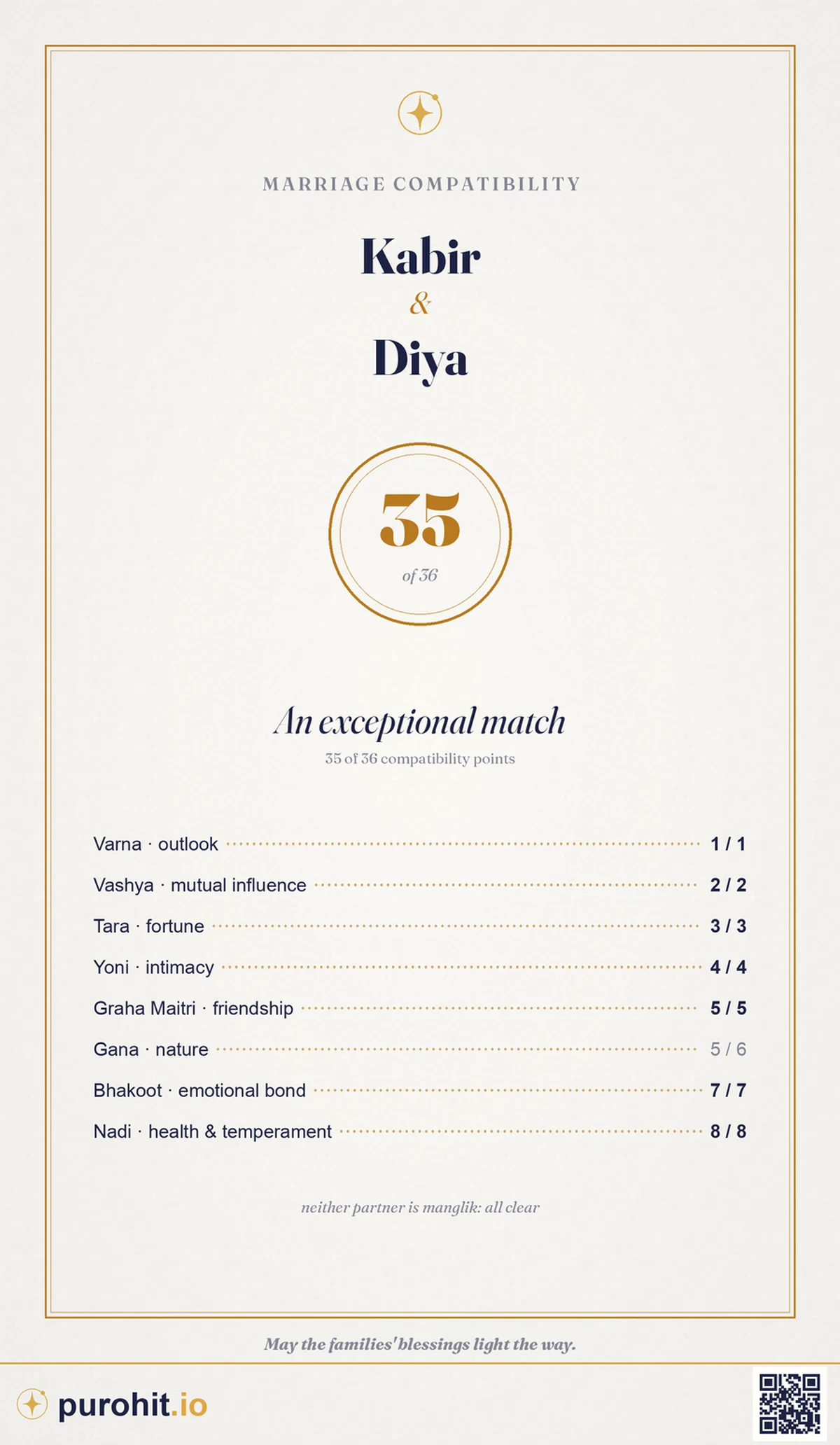
Most kundli milan checks stop at a number
Search for kundli milan online and you will find plenty of tools that hand you a single number, twenty eight out of thirty six, thirty two out of thirty six, and leave it there. Some go further and slap on a verdict like "good match" without saying what actually went into the arithmetic. That is not really a compatibility check, it is a headline.
A proper kundli milan (birth chart matching) reading should show you the working, not just the result. This article walks through the actual mechanics of Ashtakoot matching, the traditional eight fold system behind the thirty six point score, using one fully worked example so every claim is grounded in a real calculation rather than a general description.
Kabir and Diya are fictional personas used to illustrate a real, computed match score. No real couple's birth details are used here.
Kabir and Diya's card reads thirty five out of thirty six, with no dosha (affliction) flagged. That score is close to the actual ceiling of the system, and understanding why takes explaining what the number is built from.
What Ashtakoota actually measures
Ashtakoota (literally "eight kootas," or eight boxes of compatibility) is the classical Vedic system for scoring compatibility between two people ahead of marriage. The entire thirty six point score is derived from exactly one input for each partner: the position of the Moon at the moment of birth, specifically which nakshatra (one of the twenty seven lunar constellations) it sits in, which pada (quarter division of that nakshatra) it falls into, and which rashi (zodiac sign) that corresponds to.
Nothing else feeds into the guna score. Not the Sun sign, not the ascendant, not any other planet's placement. This is worth stating clearly because it is the single most common point of confusion: kundli milan is not a comparison of entire birth charts squashed into one number, it is a comparison of two Moon placements, scored against eight specific classical criteria. Everything else about a chart (career indications, health patterns, the rest of the planetary picture) sits outside the guna score entirely and gets read separately, if at all, as part of a fuller consultation.
Because the input is so narrow, the output is also narrow and precise. Two people's Moon positions plug into eight defined tests, each test returns a fixed number of points, and the eight results add up to a maximum of thirty six.
The eight kootas, in order
Here are the eight kootas (compatibility factors), each with its point value and what it is actually assessing:
- Varna, one point. A broad outlook and temperament compatibility factor, based on which of four Varna categories each Moon sign falls into.
- Vashya, two points. Mutual influence and control between the two, whether one partner tends to naturally hold sway over the dynamic or whether it is balanced.
- Tara, three points. A fortune and general wellbeing factor, comparing the counted distance between the two birth nakshatras.
- Yoni, four points. A measure tied to physical and intimate compatibility, based on the animal symbol assigned to each nakshatra.
- Graha Maitri, five points. Mental compatibility and friendship, derived from the natural planetary friendship between each partner's Moon sign lord (the ruling planet of that sign).
- Gana, six points. A temperament category, sorting each Moon nakshatra into one of three natures: deva (gentle), manushya (balanced, human), or rakshasa (intense).
- Bhakoot, seven points. An emotional and general life bond factor, based on how many signs apart the two Moon signs sit from each other.
- Nadi, eight points. A health, vitality and temperament factor tied to one of three Nadi (pulse or constitutional) categories.
Notice that the eight values themselves (one, two, three, four, five, six, seven, eight) are not arbitrary. They form a straightforward ascending sequence, and they sum to thirty six. Nadi carries the single largest weight of any koota, which is part of why it deserves particular attention below.
Graha Maitri is worth a short technical detour because it is not simply "match or no match." Classical doctrine sets out a graded scale, based on the natural friendship between the two Moon sign lords: if the two lords are mutual friends, or are the very same planet, the pairing earns the full five points; a friend paired with a neutral planet earns four; two neutral planets earn three; a friend paired with an enemy earns one; a neutral paired with an enemy earns half a point; and two mutual enemies earn zero. Kabir and Diya both have their Moon in Taurus, which is ruled by Venus for both of them, the same lord case, so their Graha Maitri comes out to a full five of five.
What a dosha actually means here
This is the part that most quick online tools get wrong or skip past entirely, and it is worth being precise about.
A dosha (affliction) in kundli milan is not simply "the total score came out low." It refers to something more specific: scoring exactly zero in one particular koota, regardless of how the rest of the chart looks. The two doshas that matter most in this system are Nadi dosha, meaning zero out of the eight Nadi points, and Bhakoot dosha, meaning zero out of the seven Bhakoot points.
That distinction matters because these two doshas can occur even in a match with an otherwise respectable score, and conversely a match can lose points in several smaller kootas without either dosha being present at all. A couple should look at the dosha flags and the total separately, not assume one tells you the other.
There is a further wrinkle specific to Bhakoot. Bhakoot dosha arises at particular sign distance pairs between the two Moon signs, specifically when the signs sit two and twelve positions apart, six and eight apart, or five and nine apart from each other. Interestingly, the seventh sign distance, direct opposition, is explicitly excluded from this rule and does not trigger the dosha. On top of that, classical doctrine allows a cancellation: if the two Moon sign lords turn out to be mutual friends, or the same planet, a Bhakoot dosha that would otherwise apply is cancelled and the points are restored in full.
Nadi dosha has no such escape clause. If both partners share the same Nadi category (Aadi, Madhya, or Antya), the koota scores zero, full stop, with no cancellation condition recognized in this framework. It is the strictest of the eight tests for exactly this reason.
Kabir and Diya's card shows why the "no dosha" line on their result can be stated honestly rather than glossed over. They score full marks in six of the eight kootas, and the only koota where they lose anything is Gana, where they score five out of six rather than a perfect six. Crucially, they score full marks in both Nadi (eight of eight) and Bhakoot (seven of seven), meaning neither dosha applies to their match at all. The one lost point is a minor gap in temperament category alignment, not a structural affliction.
Manglik status is checked entirely separately
A second common point of confusion is Manglik status, sometimes called Mangal dosha. This is a distinct astrological check that looks at the placement of Mars in each individual's own birth chart, specifically whether Mars sits in certain houses relative to the ascendant or Moon in a way classical texts flag as worth accounting for in marriage compatibility.
Manglik status is not one of the eight kootas, and it is not folded into the thirty six point total in any way. A couple can score very well on guna milan and still have one or both partners be Manglik, or score modestly on guna milan while both partners are entirely clear of it. The two checks answer different questions, and a proper kundli milan reading reports them as two separate lines rather than blending them into one figure.
For Kabir and Diya, the match card states plainly that both partners are clear of Manglik status. That is reported as its own independent line alongside the thirty five of thirty six guna score, not merged into it, precisely because folding the two together would misrepresent what each one measures.
Why 36 of 36 is not a realistic claim
Because guna milan depends on exactly one input per person, the Moon's nakshatra and pada at birth, the entire space of possible pairings can actually be counted rather than estimated. There are twenty seven nakshatras, each divided into four padas, giving one hundred and eight distinct Moon placements a person can be born under. Comparing every person's one hundred and eight possible placements against every other person's one hundred and eight possible placements gives a fully enumerable set of pairings, one hundred and eight by one hundred and eight.
Running the eight koota calculations across that entire enumerated space produces a clean result: no pairing that is free of both Nadi dosha and Bhakoot dosha ever reaches thirty six out of thirty six. The highest score achievable by any dosha free pairing in the whole space is thirty five, which is exactly what Kabir and Diya's fictional card shows.
This is not a rounding quirk or a rare edge case, it falls directly out of how the eight kootas interact given the fixed structure of nakshatras, padas and signs. So if an app, a website, or a pandit tells you a match scores a perfect thirty six out of thirty six with no dosha, that specific combination is not mathematically achievable, and it is worth asking how the number was produced.
Reading the total: verdict bands
The eight koota points add up to a total out of thirty six, and that total is generally read against broad bands rather than treated as a single sharp cutoff:
- Below 18: not recommended.
- 18 to 24: acceptable.
- 25 to 32: very good.
- 33 to 36: excellent.
These bands describe the overall total only. They do not replace checking the two individual dosha flags or Manglik status separately, since, as covered above, a match can sit in a strong band overall while still needing an honest look at whether Nadi or Bhakoot dosha is present, and Manglik always needs its own check regardless of where the total lands.
Kabir and Diya's thirty five sits comfortably inside the excellent band, and because both dosha checks come back clear and both partners are Manglik free, their fictional card can genuinely describe this as a strong match on every axis the system checks, not just a high number.
Check your own match
If you want to see this worked out for two real charts rather than a fictional one, our free kundli milan and matchmaking tool runs the same eight koota calculation, shows every individual score rather than only the total, and flags Nadi dosha, Bhakoot dosha and Manglik status as separate, clearly labeled lines. If you want the deeper technical walkthrough of how each koota is actually computed, our Ashtakoot explainer goes further into the classical rules behind each of the eight tests.
Or, if you would rather talk it through and ask questions as you go, including asking why a particular koota came out the way it did, you can message Purohit on WhatsApp and get a reading with the full breakdown, not just a headline number.