How Kundli Milan Scoring Actually Works: A Worked Example
 Purohit Ji · 2026-09-12 · 6 min
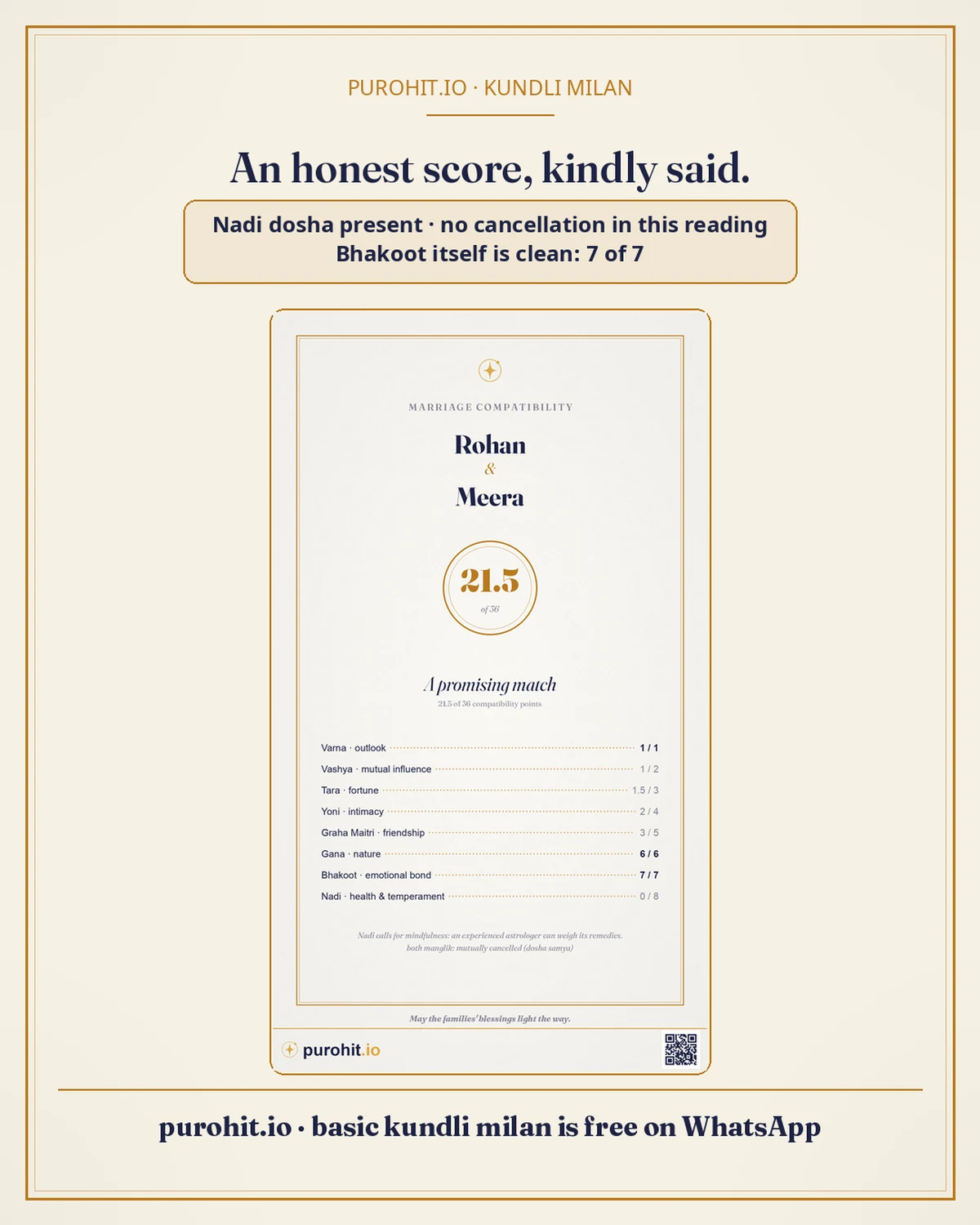
Most people who ask for a kundli milan score get back a single number, sometimes with a verdict word next to it, and nothing else. That number is doing a lot of quiet work behind the scenes: eight separate comparisons, each with its own rule, added up into one total out of thirty six. Here we are going to open that up completely, using one real computed example, and show exactly how the pieces fit together, including the part that most explanations skip past: a real dosha, and what it does and does not mean.
Rohan and Meera are fictional personas used to illustrate a real computed match score. No real couple's birth details are used here.
For this walkthrough, we gave the engine two birth detail sets, run exactly the way any user's would be: Rohan, born in Mumbai in 1997, and Meera, born in Pune in 1998. We deliberately did not pick a pair that scores near full marks. Kundli milan, also called Ashtakoot matching (ashta meaning eight, koota meaning factor or fold, so literally "the eight factor system"), is more useful when you see it produce an honest, middling number with a real flag in it, because that is the kind of result most people actually get.
What feeds the score, and what does not
Here is the part that surprises a lot of people the first time they see the mechanics: every single one of the eight kootas is derived purely from each partner's Moon at the moment of birth, specifically the Moon's nakshatra (one of the twenty seven lunar constellations the Moon travels through), its pada (a quarter division within that nakshatra), and its rashi (zodiac sign).
That is the entire input. Not the Sun sign. Not the lagna, or ascendant, the sign rising on the eastern horizon at birth, which anchors most of the rest of a kundli reading. Not any other planet's placement. Ashtakoot matching is, by classical design, a Moon-to-Moon comparison, because in Parashari astrology the Moon governs the mind, emotional temperament, and day to day disposition, which is what this particular system is trying to compare between two people.
This matters for reading the result honestly: a strong kundli milan score says the two Moons harmonize on this specific set of classical factors. It does not, by itself, say anything about the rest of either chart.
The eight kootas at a glance
Each koota carries its own maximum points, and they do not carry equal weight. Here is the full list, with the theoretical ceiling for each:
- Varna (spiritual or work-nature compatibility): 1 point
- Vashya (mutual influence and control in the relationship): 2 points
- Tara (health and general wellbeing, based on nakshatra counting): 3 points
- Yoni (physical and instinctive compatibility): 4 points
- Graha Maitri (friendship between the two Moon sign lords): 5 points
- Gana (temperament grouping: deva, manushya, or rakshasa): 6 points
- Bhakoot (emotional and material harmony, from Moon sign distance): 7 points
- Nadi (health and constitutional compatibility): 8 points
Add those up and you get thirty six, which is why the system is often just called "the 36 point score." Bhakoot and Nadi carry the two heaviest weights on their own, fifteen of the thirty six points between them, which is part of why they get singled out as the two doshas people ask about most. If you want the full mechanics behind each of the other six kootas, we have a deeper explainer at /learn/ashtakoot-explained.
Rohan and Meera's actual numbers
Run through the engine, Rohan and Meera's charts come back with a total of 21.5 out of 36. Purohit's engine sorts that into four bands: below 18 is not recommended, 18 to 24 is acceptable, 25 to 32 is very good, and 33 to 36 is excellent. 21.5 lands squarely in the acceptable band.
That is not a failing result, and it is not a warning to be alarmed by. It means the pair agrees on a solid number of the eight comparisons, disagrees or scores partially on others, and, as we will get into, scores a flat zero on one specific koota. The half point in 21.5 comes from Tara and Yoni, which can each contribute a fractional value depending on the exact nakshatra and pada combination, rather than only ever landing on a whole number.
We think a score like this is more informative than a score of 32 or 35 would be, precisely because it shows the system doing real work instead of just confirming what a rosier, rounder number might have implied on its own.
The Nadi dosha, explained honestly
Nadi is the koota worth the most points on the whole chart, eight of the thirty six, and it is also where Rohan and Meera's score takes its real hit.
Classical Jyotish groups all twenty seven nakshatras into three Nadi types: Aadi, Madhya, and Antya. Think of Nadi as a constitutional or health-temperament category tied to each nakshatra, going back to an old classification of physiological and psychological type. The rule for this koota is simple to state: if both partners' Moon nakshatras fall in the same Nadi type, the koota scores zero.
In Rohan and Meera's case, both Moons land in the Madhya nadi group. Same nadi, same group, so this koota scores zero out of eight, no partial credit.
Here is the part worth being direct about: some traditions describe a cancellation, sometimes called Nadi dosha pariharam, based on the specific pada within the nakshatra, arguing that certain pada combinations soften or void the dosha even when both partners share a Nadi type. Purohit's engine does not implement that exception. We looked at it and left it out on purpose, because it traces back to a single, unverified source rather than a claim we could cross check against multiple classical texts or independent references the way we do for the rest of the engine. Rather than quietly apply a rule we could not verify, the engine states the plain classical position: same Nadi, zero points, full stop. If that changes, it will be because we found real corroboration, not because a zero score is uncomfortable to report.
Bhakoot came back clean
Bhakoot is the other high-value koota, seven points, and it is where Rohan and Meera's chart actually does well: a clean 7 of 7, meaning no dosha here at all.
Bhakoot is measured differently from Nadi. Instead of grouping nakshatras, it looks at the distance between the two partners' Moon signs, counted in signs around the zodiac. Specific distances are flagged as problematic under classical rules: 2 and 12 signs apart, 6 and 8 signs apart, and 5 and 9 signs apart. Interestingly, 1 and 7 signs apart, direct opposition, is explicitly not flagged, even though it sounds like it should be the most extreme case.
Even when a pairing does fall into one of the flagged distances, Bhakoot dosha can be cancelled if the lords of the two Moon signs (the ruling planet of each sign) are mutual friends, or if it is the same planet ruling both signs. That is a real, classical cancellation condition, and it is one the engine does implement, because it is well attested.
None of that cancellation logic was even needed for Rohan and Meera. Their Moon signs simply did not fall into a flagged distance in the first place, so Bhakoot scored full marks on its own terms. Full marks here means exactly what it sounds like: no dosha to explain away, no exception invoked, just a clean comparison.
What this score is not
A few things worth saying plainly, because kundli milan gets over-read constantly.
The 36 point score is not a verdict on whether two people should or should not marry. It is a structured comparison of two Moon placements across eight classical factors, nothing more and nothing less. Families and astrologers have historically treated it as one input to weigh alongside a great deal of other consideration, not as an automatic yes or no.
It is also not the same check as Manglik status (a Mars placement pattern in the chart that classical astrology flags as relevant to marital harmony). Manglik dosha is checked completely separately from the 36 point Ashtakoot score in this engine, using its own rules based on Mars's house position in each partner's chart. The two are related concerns in classical practice, but they are not the same calculation, and they should not be folded into one number. You can check Manglik status on its own at /calculators/manglik.
And a score like 21.5 is not something to hide or feel discouraged by. We built this walkthrough specifically because we think an honest, middling score with a real dosha named in it is more useful than a suspiciously perfect one. The number is worth something precisely because it was not softened.
Check your own score
If you want to see this same breakdown for your own pair, birth details in, eight kootas out, individually scored rather than only totalled, you can run it yourself with the free matchmaking tool at /matchmaking. For the deeper mechanics behind each of the eight kootas, including the ones we only summarized here, see /learn/ashtakoot-explained. Manglik status is checked on its own page at /calculators/manglik, since it never gets folded into the 36 point total.
Or, if you would rather talk it through, you can message Purohit directly on WhatsApp and ask it to walk you through your own score, koota by koota, the same way we just did here: message Purohit on WhatsApp.