Free Kundli by Date of Birth: Exactly What You Get
 Purohit Ji · 2026-09-12 · 9 min
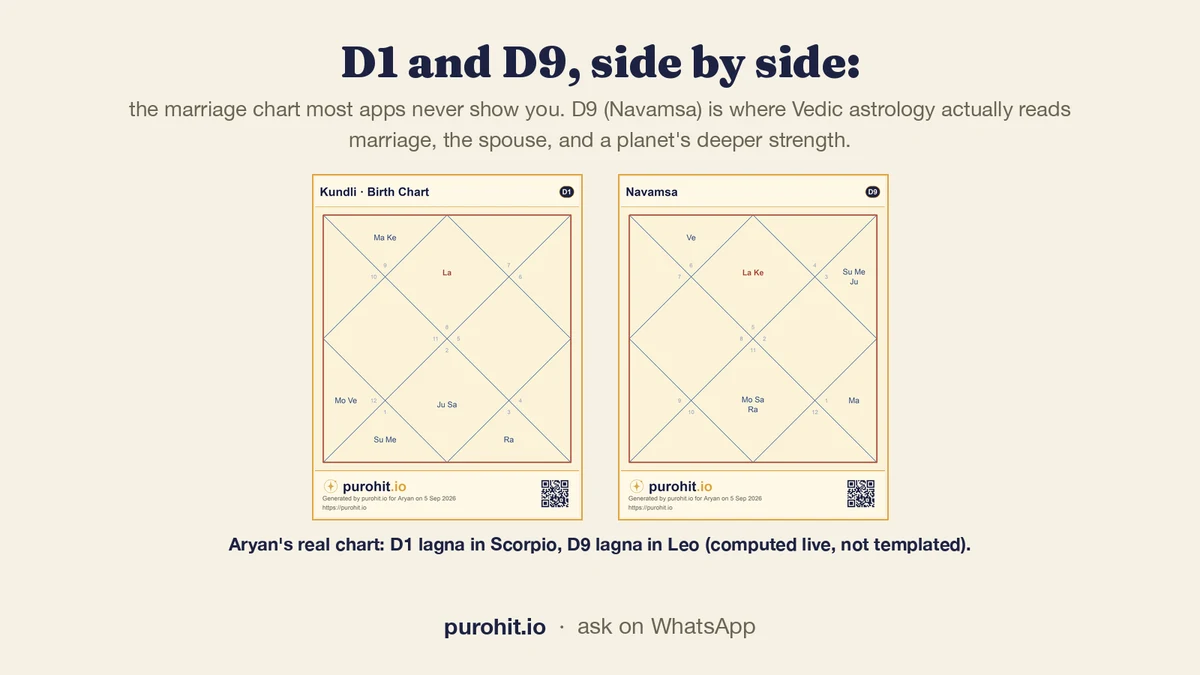
If you have ever asked for a "free kundli" online, you have probably run into two problems. Either the sheet you get back is a thin, generic printout that could belong to almost anyone born that year, or it is dense with technical tables you have no way to check, some of which the site may not even be computing correctly. We wanted to do something more honest: tell you exactly what our free kundli sheet contains, in plain language, and let the computation itself back up every claim.
This post walks through every section of the free kundli sheet you can generate right now at /kundli, in the order it appears, so you know precisely what you are looking at before you even generate one.
Why "computed" is the whole point
Before the section by section walkthrough, one distinction matters more than any single feature: everything on this sheet is calculated by a deterministic astronomy engine (Swiss Ephemeris, using the sidereal zodiac with the Lahiri ayanamsa, which is the standard reference point Vedic astrology uses to measure the sky). Nothing on the sheet is typed into a template based on your sun sign, and nothing is guessed by an AI language model reading your birth details and producing plausible-sounding prose. The planetary positions, the dasha dates, the dosha verdicts, all of it comes from the same math that observatories and serious Jyotish software rely on. If you generate your kundli twice with the same details, you will get the same chart both times, because it is arithmetic, not a language model's best guess.
That distinction is the reason we can walk through the sections below in such specific detail: each one is a fixed, well-defined calculation, not a loose description of "what usually appears" on a kundli.
Your identity and vitals
The sheet opens with an identity header: your name, birth date, birth time, birth place, and the geographic coordinates used for the calculation. Coordinates matter more than most people expect, since two towns with the same name in different states or countries would produce different charts.
Right below that sits the Kundli Vitals section: your ascendant (called the lagna, the sign that was rising on the eastern horizon at the exact moment you were born) with its degree, followed by every planet's sign, degree, and house, all read from your D1 birth chart (the main chart, described in more detail further down). This is the backbone the rest of the sheet builds on. If you want a fuller explanation of how to read these placements, see how to read a kundli.
Panchang at birth
Right after your vitals, the sheet shows the Panchang at Birth: the five classical "limbs" of the Vedic calendar calculated for the precise moment you were born, rather than for the day as a whole. These five are the tithi (lunar day), nakshatra (the lunar mansion the Moon occupied), yoga (a paired sun-moon calculation used for classifying the day), karana (a half-tithi division), and the vaar (the weekday). Panchang details are commonly used in classical Jyotish to time rituals and understand the character of a specific birth moment, and because they are calculated for your exact birth time rather than a rounded day, they will not always match a generic "born on this date" panchang lookup.
What is running right now: the current dasha panel
Just below the panchang, the sheet gives you a compact Current Dasha panel: which Vimshottari mahadasha (the major planetary period, one of a sequence of nine ruled in turn by each of the nine grahas) and which antardasha (the sub-period running inside it) are active for you today, plus when the next change happens. Vimshottari dasha is the classical timeline Jyotish uses to describe which planet's influence is considered dominant during a given stretch of your life, and this panel is the fast answer to "what period am I in right now."
The full life timeline: the Vimshottari dasha table
Below the compact panel sits the full picture: a complete Vimshottari dasha table listing every mahadasha and every antardasha across your life, each with its own start and end date, not only the one running today. This lets you look ahead or look back, whether you are curious about a period years from now or want to understand what period you were in during an event from your past. For a fuller explanation of how these periods are derived and what they mean, see dasha explained.
The planet table
The planet table lists every graha (planet) again, this time as a dedicated table rather than a summary: sign, degree, house, and, where the underlying data supports it, its Shadbala based relative strength. Shadbala ("six-fold strength") is a classical method of scoring how strong a planet's placement is by combining six separate measures, and where we can compute it reliably for a given chart, this table reflects that scoring rather than leaving planet strength as a matter of impression.
Graha drishti: who is looking at whom
Next comes graha drishti, the planetary aspects: a table of which planets cast their gaze on which houses or on which other planets. In Parashari astrology, an aspect is treated as real influence, not decoration, so knowing which planets are aspecting a given house changes how that house should be read. This section shows those relationships directly rather than leaving you to work them out sign by sign.
Sarvashtakavarga: how much support each house has
The Sarvashtakavarga (SAV) section is a twelve row table, one row per house, showing the combined bindu (point) count that all seven grahas together contribute to that house, along with a plain-language band label of strong, average, or gentle for quick reading. This is a single combined total per house, drawn from the classical Ashtakavarga system of scoring planetary support house by house. It is worth being precise about what this is not: it is not a full per-planet Ashtakavarga breakdown table showing each of the seven planets' individual contributions to every house separately. What you get is the house-by-house combined total, which is the figure most commonly used to judge the overall strength of a house at a glance.
Notable yogas
The Notable Yogas section lists the classical planetary combinations present in your specific chart, but only the ones distinctive or rare enough to say something meaningful about you individually. Jyotish texts describe a very large number of possible yogas, and many charts technically qualify for several extremely common ones that would not tell you anything you couldn't already guess. Rather than padding the sheet with those, this section surfaces only the combinations that are actually informative for your chart, so a short list here means your chart doesn't happen to carry many rare configurations, not that the check was skipped.
Dosha check: Manglik, Guru Chandal, Kaal Sarp
The Dosha Check section runs three classical checks directly against your planetary positions: Mangal dosha (commonly called Manglik status, a Mars placement pattern often discussed in the context of marriage compatibility), Guru Chandal yoga (Jupiter placed together with Rahu, one of the lunar nodes), and Kaal Sarp dosha (a pattern where all seven classical planets fall on one side of the Rahu-Ketu axis). Each of these is computed from the actual chart geometry rather than asserted, and where a classical cancellation condition applies (for example, certain Manglik cancellations), the sheet reflects that too rather than giving a flat yes or no. A dosha, in this framing, is a pattern worth understanding, not a verdict to be alarmed by.
The three divisional charts: D1, D9, D10
The sheet closes with three chart diagrams, drawn in whichever style you prefer, North Indian, South Indian, or East Indian:
- D1 (Rasi): your main birth chart, the same chart the vitals section above is read from, showing where every planet sat in the sky at the moment you were born.
- D9 (Navamsa): a divisional chart derived mathematically from your D1 positions, traditionally used to look more closely at marriage and at a planet's inner strength beyond what the main chart shows on its own. If you want the full explanation of how this is derived and read, see what is Navamsa.
- D10 (Dasamsa): another divisional chart derived the same way, traditionally used to look more closely at career and professional life.
All three are generated from the same underlying planetary data, so they are always consistent with each other and with the planet table above them.
What this sheet does not include, said plainly
We would rather tell you this upfront than let you assume it. Classical Jyotish includes many more divisional charts and analytical systems than the three shown here. The D4 chart (used for property and fixed assets) and the D60 chart (used for very fine grained analysis) exist in the tradition, but they are not part of this free sheet today. KP (Krishnamurti Paddhati) sub-lord analysis, a distinct system for fine timing, is not part of this sheet. Jaimini astrology's karakamsa and arudha analysis, another distinct classical framework built around significators rather than the standard planet-and-house method, is also not part of this sheet. And while the Sarvashtakavarga section above gives you the combined house-by-house total, this free sheet does not include a full per-planet Ashtakavarga table breaking that total down planet by planet.
None of that is a limitation we are trying to hide. We would rather list eleven sections we can stand behind completely than claim fifteen and leave you to discover which ones were thin.
Try it yourself
Every section described above is generated from the same computation, every time, for anyone's birth details. You can see all of it for your own chart, free, with no signup, at /kundli.
If you would rather talk through what any of it means, in plain language, with someone who can explain the specific planet, house, or classical rule behind a given line on your sheet, you can start a conversation right now on WhatsApp: message us on WhatsApp.