Diwali 2026 Date and Lakshmi Puja Timing for Delhi
 Purohit Ji · 2026-09-12 · 6 min
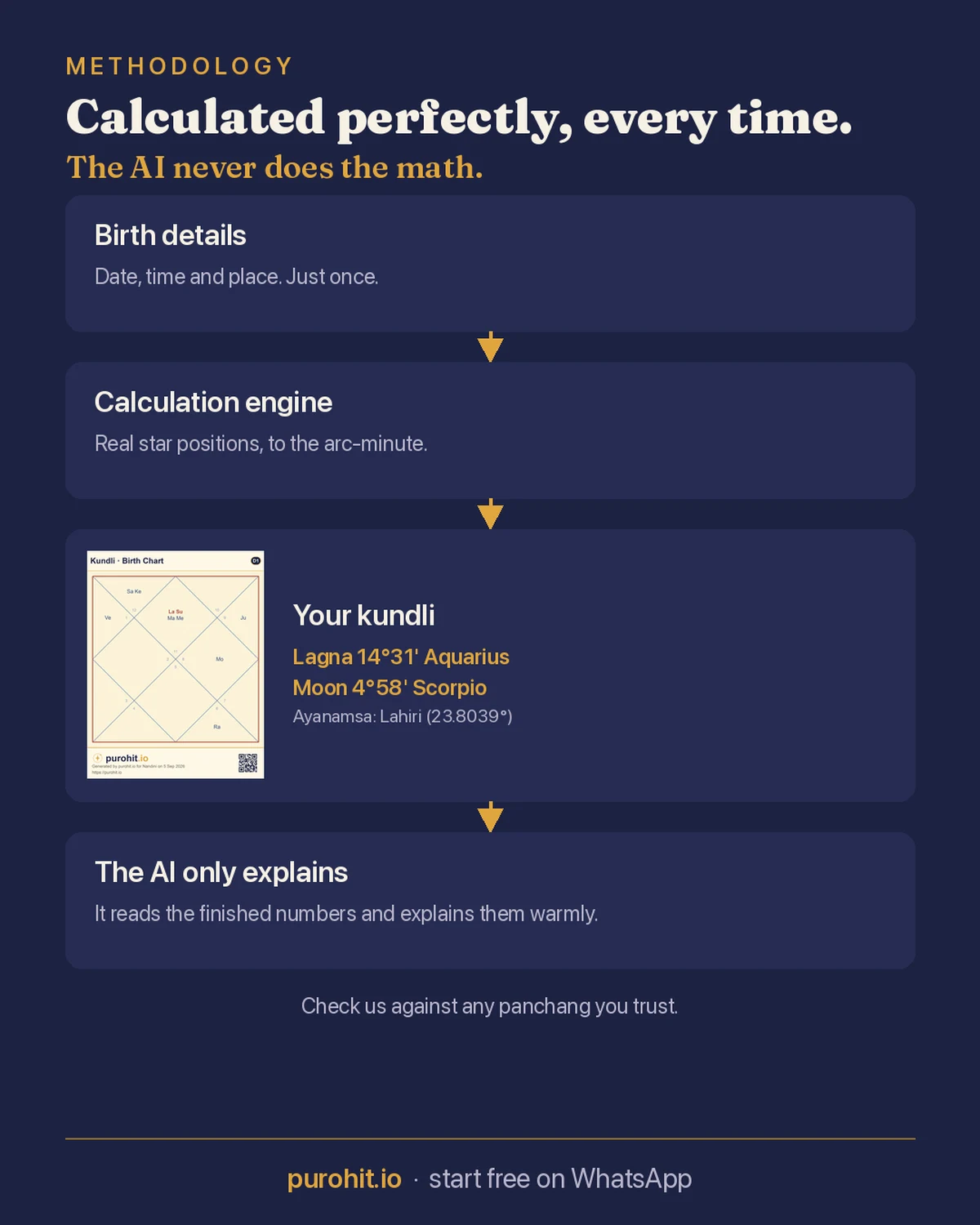
If you have already seen three different "Diwali 2026 date" answers online, you are not imagining it. Generic calendars often copy a single table forward year after year, or quote a date computed for one city and apply it everywhere. This post is not that. Every date, time, tithi, nakshatra, yoga, karana and choghadiya value below was computed directly by Purohit's own astronomy engine (Swiss Ephemeris, sidereal Lahiri ayanamsa) for Delhi (28.6139 N, 77.2090 E, Asia/Kolkata timezone) for the year 2026. Nothing here is copied from a published panchang or invented to sound plausible. It is a real calculation, and you can run the same calculation for your own city on the live page.
The date, and why it falls when it does
For Delhi, Diwali (Lakshmi Puja) falls on 8 November 2026, a Sunday.
The rule the engine follows is the classical one: Diwali is anchored to Kartika Amavasya at Pradosh. In plain words, Kartika Amavasya means the new moon (Amavasya) of the lunar month Kartika, and Pradosh Kaal is the period spanning sunset, the transition from day into evening. Lakshmi Puja is traditionally performed during Pradosh, so the correct Diwali date is whichever day has Amavasya actually in effect during that sunset window.
For Delhi on 8 November 2026, sunset is at 17:32 (5:32 pm). The tithi that day is Krishna Chaturdashi until 11:28, and then Amavasya takes over. Amavasya continues past sunset, it does not end that day, which means it is confirmed to be the active tithi during Pradosh Kaal at 17:32. That is exactly why 8 November is the correct date for Delhi this year: the new moon is in effect at the moment that matters.
This is worth sitting with for a second, because it is the part most generic calendars skip. They will hand you a date without showing why it is that date and not the one before or after. Here, the "why" is a direct output of the same computation that produced the date: sunrise, sunset and tithi boundaries, checked against each other, for this specific place and year.
The full panchang for the day
A panchang is the traditional five-part almanac reading for a given day and place: tithi (lunar day), nakshatra (the Moon's constellation), yoga, karana, and the weekday. Here is the complete picture for Delhi on 8 November 2026.
Tithi
Krishna Chaturdashi until 11:28, then Amavasya (the new moon), which is still active at and after sunset. This is the tithi transition that fixes the date, as covered above.
Nakshatra
Swati is in effect all day. There is no nakshatra change to track for this date in Delhi.
Yoga
Ayushman is in effect until 03:03 the following night, after which Saubhagya begins.
Karana
Karana moves through three segments during the day: Shakuni until 11:28, then Chatushpada until 23:57, then Naga.
Sunrise and sunset
Sunrise is at 06:38 and sunset is at 17:32. These two times anchor every other window in this post, including Rahu Kalam and the evening choghadiya below.
A note on the lunar month name
You may see this month called Ashwina in one place and Kartika in another, and both are correct, just from different conventions. By the Amanta reckoning (where the lunar month ends at Amavasya), this falls in Ashwina. By the Purnimanta reckoning (where the lunar month ends at the full moon), it falls in Kartika, which is the naming most north Indian Diwali traditions use. Both are legitimate classical systems; it is simply a difference in where the month boundary is drawn, not a disagreement about the date itself.
The evening timing picture
There is no single universal "the muhurat is from X to Y" answer for Lakshmi Puja, because the right window depends on sunset, which depends on the city. What follows is the specific, computed picture for Delhi on 8 November 2026, not a generic rule.
What to avoid
Rahu Kalam, the daily inauspicious period ruled by the shadow planet Rahu, runs from 16:10 to 17:32 in Delhi that day, ending right at sunset. This window sits just before Pradosh Kaal begins and is traditionally avoided for the puja.
Two other daily inauspicious windows fall earlier in the day: Yamaganda from 12:05 to 13:26, and Gulika from 14:48 to 16:10. Since these are all before sunset, they are not directly relevant to an evening Lakshmi Puja, but they are worth knowing if you are planning anything else that day.
The Abhijit muhurat, and why it does not apply here
Abhijit muhurat, a generally auspicious short window centered on midday, falls from 11:43 to 12:27 in Delhi on this date. It is one of the most reliably auspicious periods in the day for many purposes, but it is a midday window, not an evening one. Since Lakshmi Puja belongs to Pradosh Kaal at sunset, Abhijit is not directly usable for it this year, though it remains available for other daytime purposes on the same date.
The choghadiya windows after sunset
Choghadiya is a traditional system that divides the day and night into roughly ninety-minute segments, each carrying a label of good, bad, or neutral. Here is the sequence for Delhi starting right at sunset on 8 November 2026:
- Shubh (good): 17:32 to 19:10
- Amrit (good): 19:10 to 20:48
- Char (good): 20:48 to 22:27
- Rog (bad, avoid): 22:27 to 00:05
- Kaal (bad, avoid): 00:05 to 01:43
- Labh (good): 01:43 to 03:22
- Udveg (bad, avoid): 03:22 to 05:00
- Shubh (good): 05:00 to 06:39 the next morning
Read together with Pradosh Kaal at sunset, this gives a practical picture for Delhi: the three periods immediately after sunset, Shubh, Amrit, and Char, running from 17:32 through 22:27, are the traditionally good choghadiya windows commonly used for the evening Lakshmi Puja. Rog and Kaal, later that night, are traditionally avoided.
This is a computed, city-specific picture, not a fixed universal muhurat. A different city will have a different sunset time and a different choghadiya sequence entirely, so please do not apply these exact clock times to another location.
Why this is computed, not copied
Most Diwali date articles you will find online are working from a single static table, often produced once and then reused year after year with only the year number changed, or borrowed from a calendar computed for one city and presented as if it applies everywhere. That approach breaks down the moment you are not in that one reference city, because sunrise, sunset, and tithi boundaries all shift with location.
Purohit's festivals engine does not work that way. Every value in this post, the date, the sunrise and sunset times, the tithi transition at 11:28, the nakshatra, the yoga, the karana, the Rahu Kalam and Yamaganda and Gulika windows, the Abhijit muhurat, and every choghadiya boundary, was produced by running the actual astronomy computation (jyoti.astro.festivals.festival_date and jyoti.astro.day_panchanga.compute) for Delhi's exact coordinates and time zone, for this specific year. Change the city, and the engine recomputes sunrise and sunset from that city's coordinates, then re-derives every downstream value from there. Nothing is looked up in a stored table for the new city; it is calculated fresh.
That is the difference this post is trying to make visible: a real ephemeris computation, not a memorized or generic table, and not a language model's best guess at what a panchang usually looks like. The same rigor applies to how Purohit answers questions in conversation about your own chart: computed values first, with the prompt asking for the right framing around them, never the other way around.
Get it for your own city
Everything above is specific to Delhi. If you live somewhere else, even somewhere else in India, your sunrise, sunset, and choghadiya windows will differ, sometimes by more than an hour, and in rare cases the Amavasya-at-Pradosh check can even shift which calendar day counts as Diwali.
The live tool computes all of this for any city, on demand: visit /festivals/diwali and enter your city to get your own sunrise, sunset, tithi, nakshatra, yoga, karana, and evening choghadiya windows for Diwali 2026. You can also browse other festival dates at /festivals or check any day's panchang directly at /panchang.
Prefer to just ask? Purohit is also on WhatsApp. Say hello and ask for your city's Diwali timing directly: